


Centuries of racing history boiled down to just 20 races: here’s how I did it
John Randall, who curated the list behind The Story of Horseracing in 20 Races, on the making of an epic series


The Racing Post’s epic summer series, The Story of Horseracing in 20 Races, is now into the final furlong – and you can catch up with everything you’ve missed now by joining Racing Post+ Ultimate with 60% off your first month.
The Racing Post’s very best writers, including Racing Writers of the Year such as Lee Mottershead, Chris Cook and Peter Thomas, have told the sport’s rich history, from a list of races chosen by the sport's foremost historian John Randall, until there's just one more to come in the series. What will we have chosen? All will be revealed on Monday.
In the meantime, enter the code STORY20 when you join RP+ Ultimate Monthly and you’ll get your first month for just £20, meaning you can unlock all of The Story of Horseracing in 20 Races plus loads more sensational content over the next month, including the biggest and best jumps season preview, The Big Jump Off, available in the digital newspaper from 9pm on Sunday, October 19 and the start of our jumps stable tour series with Nicky Henderson the following day.
Trying to encapsulate the whole history of this sport in just 20 races was hardly one of the most straightforward tasks I’ve ever been set at the Racing Post. So where to start?
Some contests produced great performances that could not be ignored, but even more important in the deliberations was their historical significance as I looked for races that instigated a new era in the sport.
They ranged from the obvious to the obscure – from the first running of the Derby in 1780 to the Crawfurd Handicap at Newmarket in 1895, which features nowhere in standard histories of the sport despite sparking a revolution in riding styles.
Of the 20 races, 14 were on the Flat, including three Derbys and three run outside England – one each in Ireland, France and the US. The six over jumps were all editions of the Cheltenham Gold Cup (four) or Grand National (two). The hurdle race that came closest to inclusion was the 1977 Templegate Hurdle at Aintree, which saw both the greatest ever hurdling performance and the most notable dead-heat when Night Nurse gave 6lb to his fellow titan Monksfield.
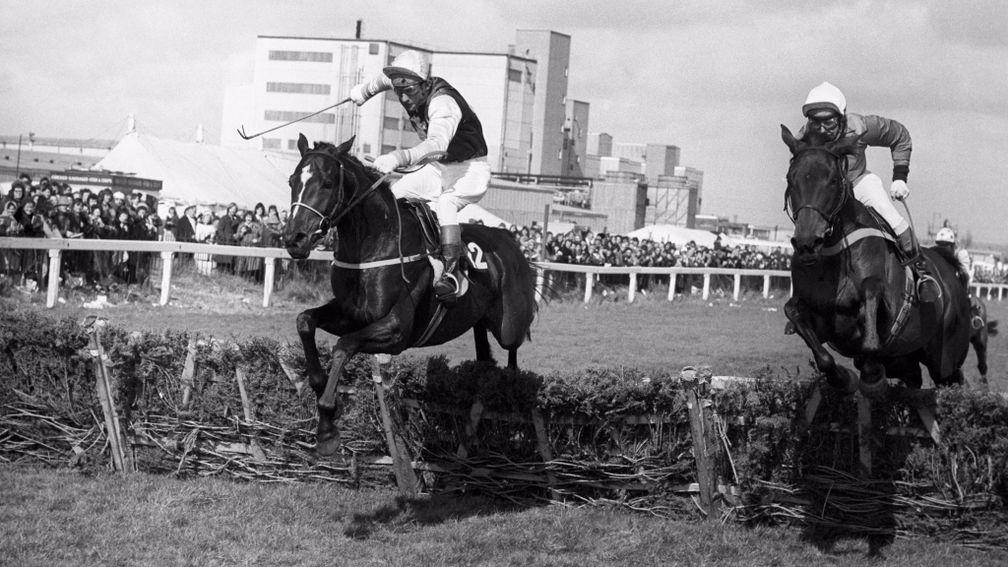
Most of the races could be split into four camps – landmark races, key innovations, superlative feats and the rise of the sport internationally. Even then, others demanded inclusion for miscellaneous reasons.
Landmark races
Among the automatic choices for the series were landmark editions of five iconic races – the inaugural runnings of the Derby and Grand National, and later ones for the Cheltenham Gold Cup, Prix de l'Arc de Triomphe and Irish Derby to mark the years in which they became championship events.
The first Derby was not significant at the time but helped to transform the pattern of racing, whereby four-mile races were replaced by ones that demanded greater speed and precocity.
The Grand National was first run in 1836 as the Liverpool Grand Steeple-Chase over almost the same course and distance as it is today, and was won by The Duke. This contradicts the received wisdom that the first Grand National was in 1839 and won by Lottery. That misconception is so deeply entrenched that even the official Aintree website propagates it, but historian John Pinfold's diligent research has disproved it.
The Cheltenham Gold Cup was first run in 1924 but was no more than a prep race for the Grand National until 1948, when Cottage Rake became the first great steeplechaser for whom it was the main target. He also propelled Vincent O'Brien into the big time.

The Prix de l'Arc de Triomphe was international in nature from its creation in 1920 but did not become Europe's championship race until 1949, when it was quintupled in value.
The Irish Derby was a parochial affair from its inception in 1866 until its prize-money was increased sixfold in 1962 through sponsorship by the Irish Hospitals Sweepstakes. It therefore served a dual function in this survey – catapulting Ireland into the premier league of world racing, and acting as a milestone in modern commercial sponsorship.
Alternatives in this category would have included the St Leger (the world's first Classic in 1776), July Stakes (the first big two-year-old race in 1786), St Albans Steeplechase (the first notable steeplechase in 1830) and inaugural King George VI and Queen Elizabeth Stakes in 1951.
Innovations
Innovations which initiated a new era in the sport, including starting stalls, female jockeys and all-weather racing, had to be recognised.
The most obscure of the 20 races was the 1895 Crawfurd Handicap, a routine event at Newmarket but one in which US champion Willie Simms started a revolution in riding styles by introducing the modern streamlined jockeys' seat to Britain.

Simms, who won the Kentucky Derby twice, rode for only one season in Britain and has been airbrushed out of our racing history, with most of the credit for instigating the new style being given to his white compatriot Tod Sloan. The latter was nicknamed the 'Monkey up a Stick' but that was originally a racist slur applied to Simms, a son of former slaves.
The first race started from stalls in Britain or Ireland, the Chesterfield Stakes at Newmarket in 1965, and the first race under rules for women riders, the Goya Stakes for amateurs at Kempton in 1972, won by Meriel Tufnell, both showed the sport was belatedly entering the modern world, while the William Hill Claiming Stakes (Division One) at Lingfield in 1989 opened Britain's first meeting on an all-weather surface.
Near-misses were contests that saw milestones for televised racing, the photo-finish camera, female trainers and Sunday racing.
International racing
One notable trend throughout the sport's history has been its increasingly international nature, so it was easy to nominate Gladiateur's Derby and the inaugural Washington DC International.
In 1865 French-bred Gladiateur became the first foreign-bred Derby winner, serving notice that Britain's supremacy would not last forever – although he would nowadays be regarded as British because he was trained at Newmarket.
The first Washington DC International in 1952, created by John Schapiro at Laurel Park, Maryland, was won by Newmarket-trained Wilwyn and pushed back forever the horizons for European horses.
Among the notable omissions were the opening race (the Juvenile) at the first Breeders' Cup in 1984, the 1993 Melbourne Cup won by Vintage Crop and the inaugural Dubai World Cup in 1996.
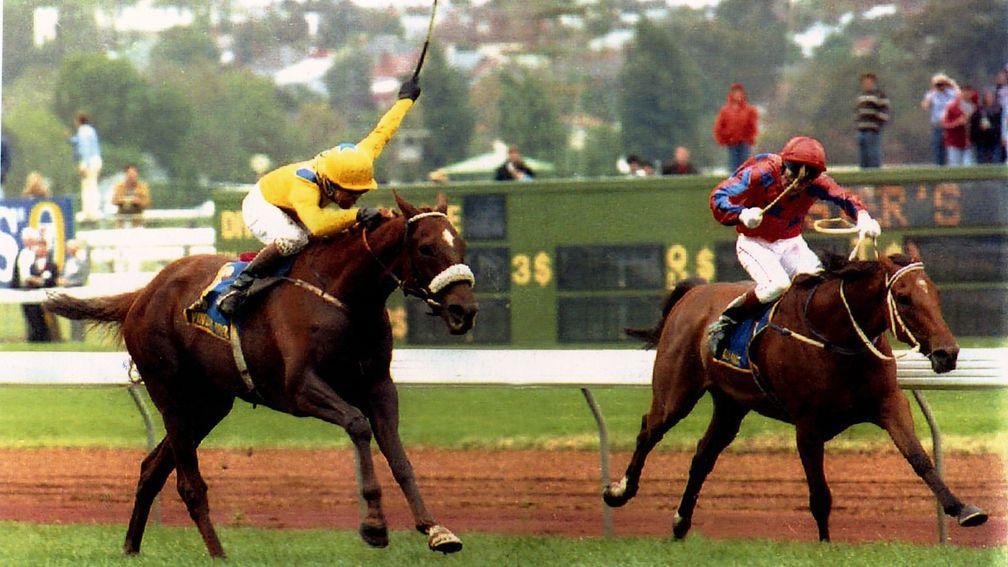
Superlative feats
In the category of superlative feats, I had to find room for Arkle, Red Rum and Desert Orchid, and for the greatest performances by a trainer and a jockey.
The mantle of supremacy passed from one great champion to another more decisively in the 1964 Cheltenham Gold Cup than in any other race as Arkle triumphed over Mill House and served notice that he was the greatest steeplechaser that had ever raced.
The last of Red Rum's three Grand Nationals in 1977, rather than the first, made the cut, given the extraordinary fanfare surrounding the horse by then; and Desert Orchid's Cheltenham Gold Cup in 1989 brought scenes rarely, if ever, seen on a racecourse since, such was his remarkable popularity with the public.

I also couldn't overlook Michael Dickinson's Famous Five in the 1983 Cheltenham Gold Cup or Frankie Dettori's unique Ascot seven-timer in 1996, completed in the Gordon Carter Handicap.
Among the many alternatives would have been the 1886 2,000 Guineas (Ormonde), 1934 Grand National (Gold Cup winner Golden Miller completing a unique double), 1965 Derby or Arc (Sea-Bird), 1971 2,000 Guineas (Brigadier Gerard v Mill Reef), 1986 Arc (Dancing Brave) and two 'Races of the Century' – the 1903 Eclipse (Ard Patrick v Sceptre) and 1975 King George (Grundy v Bustino).
Miscellaneous races
It would have been careless to omit the Bevendean Maiden Stakes at Brighton in 1977, in which Hatta became the first winner not just for Sheikh Mohammed but for any member of the Maktoum family. No-one could have realised its significance at the time.

I also chose the most famous of all matches, at York in 1851, between two great Derby winners, The Flying Dutchman and Voltigeur. As a race that shone a light on the essence of the sport, it was preferred to Eclipse's debut in the Noblemen and Gentlemen's Plate at Epsom in 1769, run in four-mile heats; the 1844 Derby, which typified the villainy and corruption of racing at the time; and the Grand Nationals of 1956 (Devon Loch) and 1967 (Foinavon), which epitomised racing's glorious uncertainty.
The 1913 Derby fits into none of the above categories, but for drama, sensation, tragedy, controversy and intrigue, there has never been another race like it, so it could not possibly be left out.
The same goes for the last race on the list, which will be revealed in Tuesday’s newspaper, providing a fitting end to what I hope you have found a most enjoyable series.
The full Story of Horseracing in 20 Races series:
1. The day racing changed forever: how the 1780 Derby sparked a 250-year turf revolution
2. The Grand National didn't start in 1839 - this is the true story of racing's greatest race
4. 'The killer of the English' - Gladiateur and the day Britain lost control of its greatest race
5. How a son of slaves was mocked and abused by his peers - but then imitated forever
18. ‘What a waste of money,’ they cried - now racing couldn’t do without this vital lifeline
To celebrate The Story of Horseracing in 20 Races, the Racing Post's epic weekly series that has run through 2025, you can get your first month of Racing Post+ Ultimate for £20 when you sign up via web using code STORY20 – that's a whopping 60% discount. Available only to new and returning customers. Subscription will auto-renew at £49.95 unless you call our cancellation line to cancel. Sign up now.
Published on inThe Story Of Horseracing In 20 Races
Last updated
 Copy
Copy- Frankel was truly the GOAT - and this was the jaw-dropping moment when he left the rest behind
- From Frankie's seven to Dessie's Gold Cup, the countdown is nearly over - which race will complete The Story Of Horseracing in 20 races?
- The Story of Horseracing in 20 Races has crossed the finish line - unlock it all now with 60% off Racing Post+ Ultimate
- 'He should have been 1-4!' - reliving the only joyful day in British racing history when everything went wrong for the bookies
- ‘What a waste of money,’ they cried - now racing couldn’t do without this vital lifeline
- Frankel was truly the GOAT - and this was the jaw-dropping moment when he left the rest behind
- From Frankie's seven to Dessie's Gold Cup, the countdown is nearly over - which race will complete The Story Of Horseracing in 20 races?
- The Story of Horseracing in 20 Races has crossed the finish line - unlock it all now with 60% off Racing Post+ Ultimate
- 'He should have been 1-4!' - reliving the only joyful day in British racing history when everything went wrong for the bookies
- ‘What a waste of money,’ they cried - now racing couldn’t do without this vital lifeline