


Five stars: Arc hero Rheingold heads the list of the best horses Barry Hills trained
Barry Hills was responsible for many outstanding performers during his long and successful career. Here we select five of his best
Rheingold
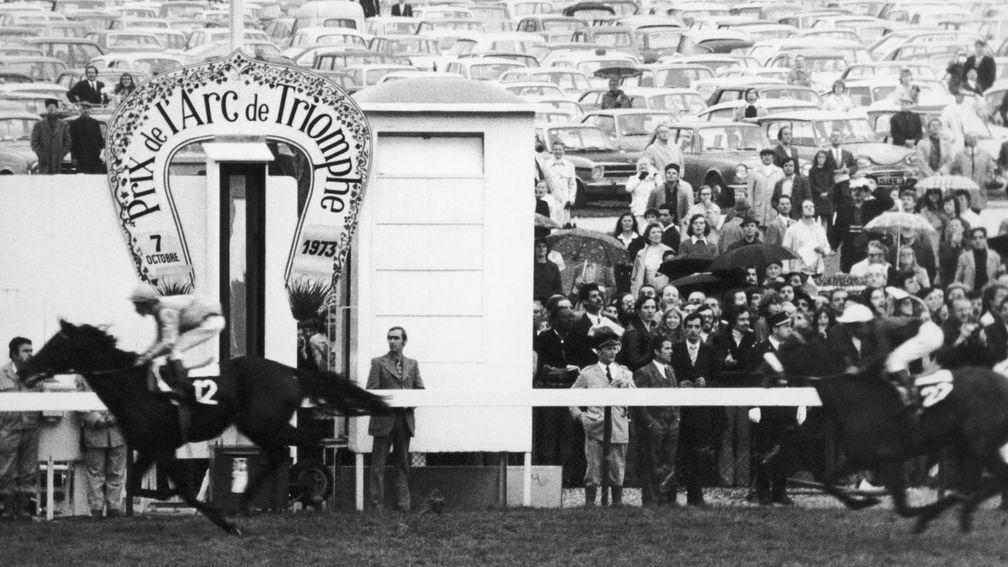
Hills's first star was his brightest and gave him the biggest win of his career in the 1973 Prix de l'Arc de Triomphe, just four years after he had taken out a licence.
Rheingold, owned by the war hero, nightclub magnate and violin virtuoso Henry Zeisel, showed his talent at two when runner-up to Crowned Prince in the Dewhurst Stakes before confirming he had trained on with success in the Dante Stakes.
Relatively unconsidered in the Derby the following month, he and Ernie Johnson would have run out clear winners had it not been for Lester Piggott summoning up one of the rides of his life to lift Roberto past Rheingold in the last four strides and win by a short head. Rheingold was in the right place but at the wrong time; Hills never did win a Derby, with Hawaiian Sound, Glacial Storm and Blue Stag all only second best.
Rheingold's career then proceeded at the highest level, his only really poor performance coming behind the runaway Roberto in that earth-shattering Benson & Hedges Gold Cup in which Brigadier Gerard was beaten for the only time in his career.
He won the Grand Prix de Saint-Cloud twice, a Prix Ganay and a Hardwicke Stakes and was runner-up in the 1973 King George to the great filly Dahlia, but at a rainy Longchamp, Rheingold had Piggott on his side not against him, and the result made up for the one that got away at Epsom.
Piggott kept Rheingold close to the pace in a huge field and drove him into the lead as the runners turned for home, getting first run on Allez France, the darling of the French turfistes. She showed grit and determination to close the gap, but Rheingold had gone beyond recall and landed the spoils by two and a half lengths.
Nomadic Way
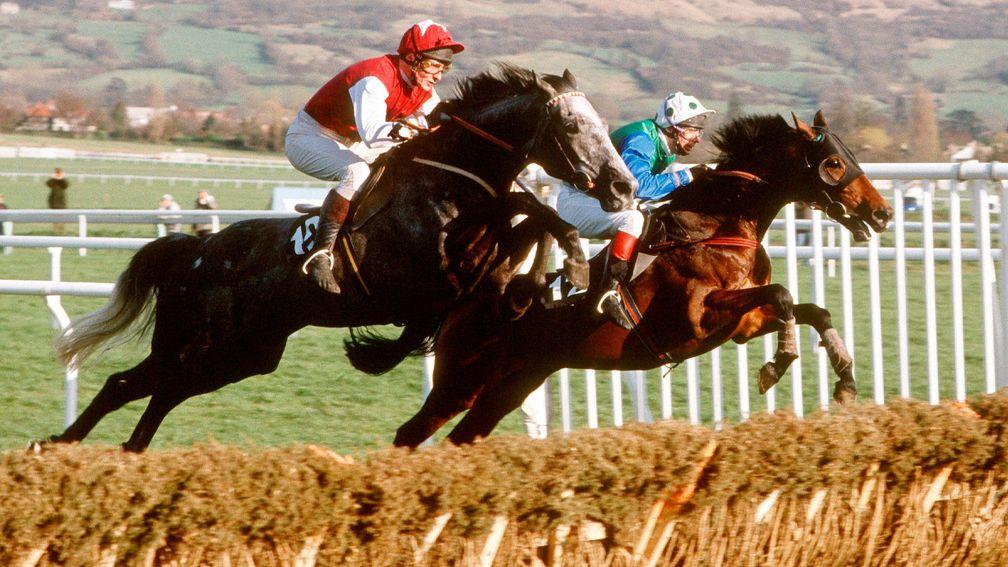
Equally at home in staying events on the Flat or in the best company over hurdles, Robert Sangster's son of Prix du Jockey-Club and Irish Derby winner Assert provided Hills with a notable success at the Cheltenham Festival in the 1992 Stayers' Hurdle.
Unraced as a two-year-old, Nomadic Way rounded off his three-year-old campaign with a gutsy victory in the Cesarewitch off a featherweight under Willie Carson, but age and maturity and eight flights of hurdles later brought out the best in him.
Three months after finishing eighth in the Triumph Hurdle he took fourth place in the Ascot Gold Cup behind Sadeem and after that his attentions were directed towards the winter game. In February 1990 he beat Elementary by six lengths in the Irish Champion Hurdle and found only Kribensis too good in the big one at Cheltenham a month later.
The following year it was Morley Street who proved his master on the Cheltenham hill, seeing him off by a length and a half, and again taking his measure in the Aintree Hurdle next time out.
Nomadic Way's hurdling career was characterised by second places – he finished runner-up in exactly half his 20 races over hurdles, including two Bula Hurdles and a Fighting Fifth – and on the Flat he was also runner-up in a Chester Cup and a Queen Alexandra Stakes, but he did not lack fight or courage and a step up in trip proved the key to his finest hour. In his first race beyond three miles, he kept on strongly from the top of the hill in the Stayers' Hurdle to beat a classy field in style by three and a half lengths, rich reward for his near-misses over two miles in the previous two years.
His versatility had one more manifestation: still a full horse, he retired to stud the following year.
Further Flight

Few horses manage to achieve something no other has done, but Simon Wingfield Digby's ghost-grey stayer carved himself an enduring niche in racing history by winning five consecutive runnings of the Group 3 Jockey Club Cup, becoming the only horse ever to win the same Group race five times.
There were better horses around, there were faster horses around, but Further Flight built himself a fervent following and his appearances at Newmarket in the autumn were hugely anticipated and deeply enjoyed.
His talent first flowered on a major stage with victory in the 1990 Ebor in which, under regular rider Michael Hills he kept on stoutly with trademark determination to beat Bean King by a length and a half.
A year later he successfully made the transition to Group races, winning the first of nine Group 3s when seeing off Great Marquess to land the first of his two Goodwood Cups and two months later began the five-year odyssey that would eventually set him apart from his peers.
In the 1991 Jockey Club Cup he beat Supreme Choice by a length and a half, in 1992 he extended that advantage over Supreme Choice to five lengths. He was at his peak that year, with Cup wins at Goodwood and Doncaster under his belt, and although he was never so dominant again he still proved unstoppable in 'his' race. In 1993 he beat Edbaysaan by two lengths, a year later he thrashed Capias by seven lengths in a moderate renewal, and he completed the five-timer at the age of nine, drawing clear up the hill to beat Assessor by two and a half lengths before receiving a hero's reception in the winner's enclosure.
His last victory came at the age of 12, in a race at Nottingham that now bears his name.
Cormorant Wood

In the early part of her racing career, Cormorant Wood looked like being another nice filly to add to the list of nice fillies Hills had handled, but nothing to compare with the talented Dibidale, winner of the Irish and Yorkshire Oaks in 1974, who might well have won the Epsom version had her saddle not slipped, leaving Willie Carson to ride the final furlong effectively bareback.
Cormorant Wood, owned by the trainer's old pal Bobby Mcalpine, won one from two as a juvenile over six furlongs and in the early part of her three-year-old season was campaigned with the Oaks in mind. But having been placed in the Lingfield trial, she faded into sixth at Epsom, was beaten in the Princess of Wales's Stakes at Newmarket and then rerouted down the path to excellence over two furlongs shorter.
The new journey began at Newcastle, where she landed the Virginia Stakes, teeing herself up nicely for a glorious autumn. At the start of October, with Hills's former prodigy Steve Cauthen in the saddle, the daughter of Home Guard started a 7-2 shot for the Sun Chariot Stakes at Newmarket, landing the then Group 2 from Sedra by a length. It was a moment of magic and also a marvellous prelude to greater glory, as Cormorant Wood was inked in for a return to the Rowley Mile a fortnight later.
The contest was the Champion Stakes, featuring a range of Group 1 talent, from the top miler Wassl to Arlington Million hero Tolomeo and Coronation Cup winner Be My Native, but although the field had to contend with a blustery wind, it was as nothing compared to the whoosh as Cormorant Wood surged from the back of the field to score with authority.
Dropped back to a mile as a four-year-old, she dead-heated with old rival Wassl in the Lockinge, but following defeat in the Queen Anne she returned to ten furlongs to slam Tolomeo, Chief Singer and Sadler's Wells in the Benson & Hedges Gold Cup (later the Juddmonte International) at York.
It was to be her last racecourse appearance. Cormorant Wood was found to have a career-ending tendon injury and was retired to the paddocks as the top filly on the international classifications and one of the best Hills ever trained.
Haafhd

Hills was in his fifth decade with a licence and just seven years from retirement when he trained one of the best he had ever had, a colt called Haafhd, owned by Sheikh Hamdan Al Maktoum, who looked high class from the time he followed up a winning debut by landing the Washington Singer Stakes at Newbury.
Defeats in the Champagne and Dewhurst Stakes rather dented the enthusiasm of the markets, but not that of the trainer. The pace hadn't been strong enough in the Dewhurst, he explained; he hadn't been quite right at Doncaster; and he'd been working in scintillating fashion in the lead-up to the Craven; so his five-length win came as no surprise to Hills, who was adamant that here was the best miler he'd ever trained and a valid 11-2 shot for the 2,000 Guineas.
His faith was duly borne out on the Rowley Mile, as the trainer's instructions to "take the race to them" on a horse with a "laid-back attitude to life" were followed to the letter by his son in the saddle. Richard Hills went on to the Rowley Mile full of confidence and was rewarded with a bold, attacking performance that yielded a definitive victory over Snow Ridge, Azamour and Grey Swallow.
Quicker ground was offered as a contributory factor in defeat behind Azamour in the St James's Palace, and Hills was concerned that the yard was under a cloud when Haafhd finished down the field in the Sussex Stakes, but although the season ended with a "long and painful three months", there was always light at the end of the tunnel, the feeling that the step up to a mile and a quarter with a little give in the ground would issue in a return to form for his star.
As it turned out, there was more rain than Hills felt was ideal when Haafhd finally returned as a 12-1 shot for the Champion Stakes at Newmarket. He needn't have worried; the son of Alhaarth was always travelling best in behind the leaders, moved up smoothly to tackle Chorist and pulled convincingly clear, with Azamour well beaten in third.
Haafhd was retired to stud at the peak of his powers but Hills was left with the memory of a crack colt who lived up to his expectations.
Barry Hills 1937-2025:
Barry Hills, legendary trainer and head of a major racing dynasty, dies at the age of 88
'It took several months to get all the money on' - Barry Hills on the gamble which launched a legacy
Published on inBarry Hills 1937-2025
Last updated
 Copy
Copy- 'He was brought up in a tough world, so to get where he did was extraordinary' - Henderson leads Lambourn tributes to Barry Hills
- 'Barry liked to lay one out but he was secretive about it - we had to guess which horse it was and nine times out of ten we were wrong!'
- Steve Cauthen: 'Barry Hills taught me how to be a man and ignited my passion to want to be the best'
- Barry Hills: a man with a razor-sharp sense of humour and a tongue that could make shrinking violets of the most robust
- 'He did it all from scratch' - 'streetfighter' Barry Hills conquered racing's peaks and became a Lambourn legend
- 'He was brought up in a tough world, so to get where he did was extraordinary' - Henderson leads Lambourn tributes to Barry Hills
- 'Barry liked to lay one out but he was secretive about it - we had to guess which horse it was and nine times out of ten we were wrong!'
- Steve Cauthen: 'Barry Hills taught me how to be a man and ignited my passion to want to be the best'
- Barry Hills: a man with a razor-sharp sense of humour and a tongue that could make shrinking violets of the most robust
- 'He did it all from scratch' - 'streetfighter' Barry Hills conquered racing's peaks and became a Lambourn legend