


- More


'Bad draw' non-runner sparks rare use of BHA rule – but what does it mean for punters?
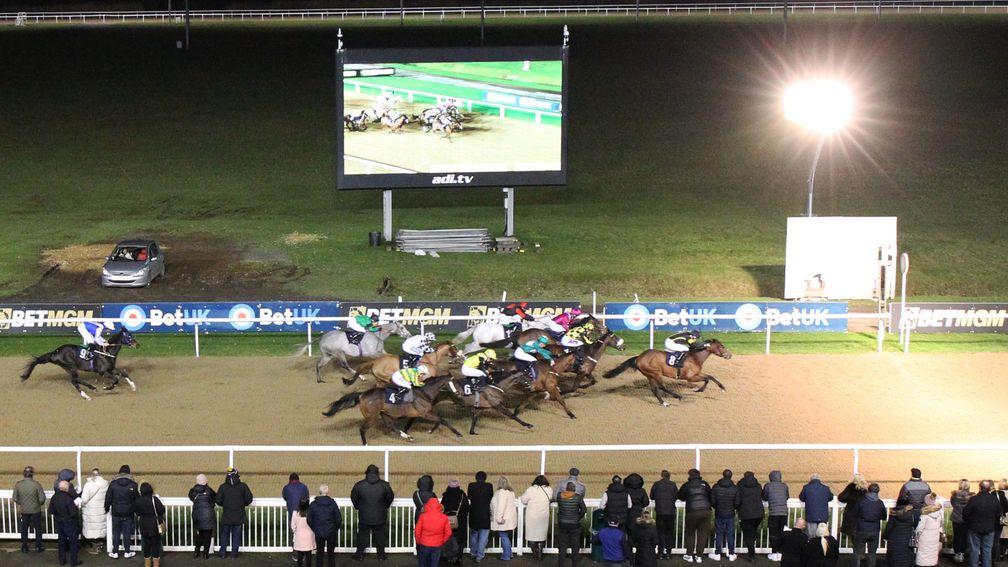
Craig Benton and his horse Twitch were not expected to feature among the headlines heading into a weekend featuring the Ayr Gold Cup and Mill Reef Stakes.
However, Benton and Twitch became an interesting topic of conversation after the trainer, based in Epsom, declared his eight-year-old a non-runner from a lowly handicap at Wolverhampton on Saturday evening, citing "bad draw" as the reason.
But just what is the ruling that has enabled Benton to use such reasoning, and why aren't more trainers pulling the same move?
What happened?
Twitch was set to run at Wolverhampton on Saturday and was drawn wide in stall 12 for a 7f handicap. He was taken out of the race on a self-certificate, with the reason given as 'bad draw'.
The gelding's trainer Benton said the following day that "honesty is the best policy" and stated the stewards were content with the explanation he had provided.
It is extremely rare for 'bad draw' to be listed as the reason for withdrawal. Of the 4,521 non-runners on the Flat in Britain last year, none were taken out due to a bad draw, and Twitch is the first instance this season.
What does the rule say?
A self-certificate allows trainers to take horses out of engagements without the need for a vet’s certificate or the threat of disciplinary action.
Trainers are required to provide further explanation if a horse is declared a non-runner for the reasons ‘other’, ‘travel’ or ‘self-cert (other)’.
According to section 44 of the race entry code in the BHA rules of racing, the only reason a trainer cannot give when issuing a self-certificate is “if not running is related to the race’s prize-money”. Horses cannot run for seven days after being declared a non-runner on a self-certificate.
What is the BHA position?
Declaring a horse a non-runner because of a 'bad draw' is allowable in the rules, as self-certificate can be used for any reason other than prize-money. However, the trade-off is that the horse then cannot run for seven days.
It is a topic that has been discussed at various points down the years. The prevailing view is that the regulator would prefer trainers to be honest, instead of providing a fake reason like 'not eaten up', for example.
There are some jurisdictions where connections would receive a fine for not running due to a bad draw, but in those places a seven-day penalty is not in place, although it could be argued that is less of a deterrent.
While it is true to say the BHA's rules and guidelines are under constant review, the understanding is that, given its rarity, the issue of non-runners being declared due to a 'bad draw' is not at the top of the agenda.
What does it mean for punters?
The fear is that this may open the floodgates for more trainers to adopt such reasoning, potentially adding an element of chaos into betting markets.
Twitch, however, was not a late non-runner – he had been removed from the race on Thursday, the day of declarations – and so the impact of Benton's decision was not a factor for the on-the-day market, or on-course punters.
It is a nuance Sean Trivass, chair of the Horseracing Bettors Forum, pointed to, saying: "The HBF accepts the candour of trainer Craig Benton on this occasion, though we hope this doesn't set a precedent.

"As long as bookmakers refund any early bets, the make-up of the race is not altered regarding place terms, and if connections are happy to take the enforced self-certification sabbatical, then there's little that can be done that we're aware of.
"We do acknowledge that late non-runners can change the way a race is run, for example the withdrawal of a confirmed front-runner, and would ask trainers to withdraw in such circumstances at the earliest opportunity, ie as soon as the draw is known, as happened here."
Which racecourses have the most non-runners?
The 'bad draw' option does pose another question: if more trainers elect to use the reasoning, which courses might be impacted the most?
It is well known that a wide draw on Chester's tight circuit is less than ideal, and the Roodee track had the most non-runners per race – 1.29 – of any British Flat track last year.
Wetherby was next, though from a smaller sample of 21 races, at 1.19 non-runners per contest, ahead of Goodwood (1.16) and Ffos Las (1.13).
Judged on another metric, the percentage of non-runners against declared fields, Ffos Las fared worst at 15.2 per cent, followed by Brighton (13.5) and Haydock (13.3).
However, for now, Twitch is the only recent example of a horse being declared a non-runner due to 'bad draw'.
Read this next:

Looking for free bets? Racing Post have got the best offers, all in one place. Visit racingpost.com/freebets to find out more.
Published on inBritain
Last updated
 Copy
Copy- 'I think it would be appalling if it closed' - racegoers and professionals stand together at Kempton's last Flat meeting of the year
- 'It's a disgrace - if we lose Kempton, the Jockey Club should hang its head in shame' - Alan King adds voice to track closure concerns
- Going expected to deteriorate at weekend meetings with weather warning in place | Ffos Las succumbs to waterlogging
- Yield up but turnover down as Levy Board outlines 'significant challenges' facing British racing
- 'We're still on cloud nine' - Faye Bramley could return to Cheltenham with Glengouly on New Year's Day
- 'I think it would be appalling if it closed' - racegoers and professionals stand together at Kempton's last Flat meeting of the year
- 'It's a disgrace - if we lose Kempton, the Jockey Club should hang its head in shame' - Alan King adds voice to track closure concerns
- Going expected to deteriorate at weekend meetings with weather warning in place | Ffos Las succumbs to waterlogging
- Yield up but turnover down as Levy Board outlines 'significant challenges' facing British racing
- 'We're still on cloud nine' - Faye Bramley could return to Cheltenham with Glengouly on New Year's Day