


“I’ve not managed to speak to one guy who knows anything about horses or farming’ - stud owners in limbo amid anxious wait for solar farm resolution
Alex Frost and Dermot Farrington chat to Andrew Scutts about concerns over the solar park project on their doorstep

This month’s Badminton Horse Trials, seeing they were hosted by the Duke of Beaufort, seemed an opportune time to catch up with the stud owners facing an uncertain future due to a plan to build a 2,200-acre solar farm.
Part of the proposed Lime Down Solar Park would be on the duke’s 52,000-acre Badminton estate in Gloucestershire, as well as on land in a triangle between the market towns of Malmesbury, Tetbury and Chippenham.
The duke is one of ten landowners backing the industrial-scale development which, if given the go-ahead, would dramatically impact England’s oldest borough Malmesbury and surrounding towns and villages.
The Fosse Way, a Roman road and scheduled monument, would be enveloped by solar infrastructure, while the area contains historically significant footpaths and bridleways.
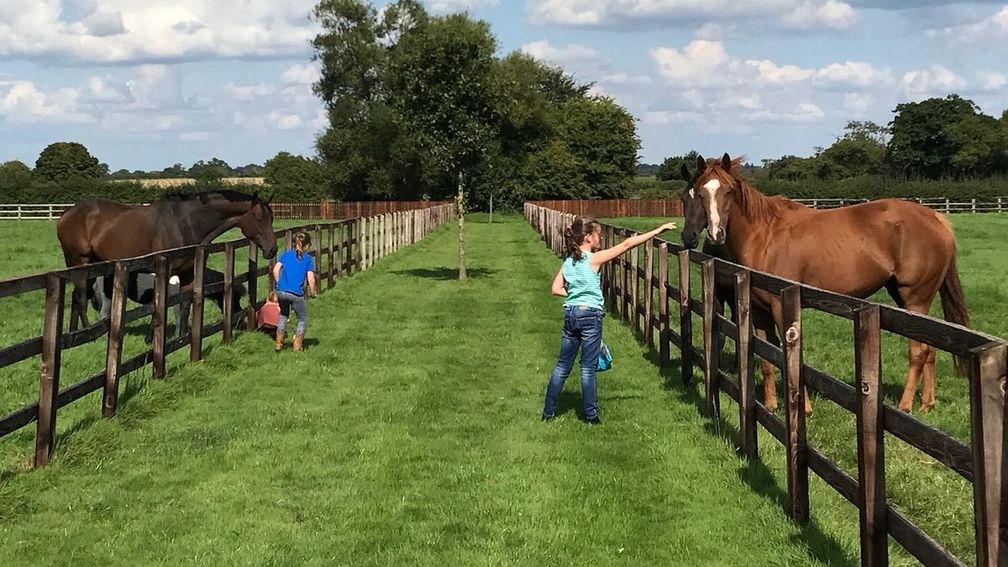
It is also home to Ladyswood Stud in Sherston, owned by Alex Frost, and West Park Farm in Corston, run by Dermot Farrington.
The pair spoke for themselves but also thousands of like-minded local people last summer when they shared fears the solar park would wreck the area for businesses, homeowners, walkers, riders, tourists and biodiversity.
The scheme, which has gone through two stages of community consultation, is classified as a Nationally Significant Infrastructure Project due to its scale, meaning permission needs to come from the secretary of state for the Department of Energy Security and Net Zero, rather than Wiltshire Council, which has voted against it.
Ed Miliband was appointed to that position on July 5 last year after the Labour Party’s general election win and within a week had approved the equally controversial Sunnica solar and battery farm close to some of Newmarket’s most important gallops.
That was despite a four-year campaign against it by key racing bodies, local MPs and several councils.
And, as Frost points out, despite UK government policy mandating the prioritisation of brownfield sites and rooftop development for renewable energy initiatives.
In the Sunnica case, the plan is to cover 2,800 acres of arable land on the west Suffolk and east Cambridgeshire border. While that is bigger still than the Lime Down proposal, Wiltshire already has eight out of ten of the largest solar farms in Britain.
Frost, Farrington and the army of campaigners opposed to the Lime Down development hope the tide is turning, in terms of public acceptance of renewable energy projects and concerns about land use and environmental impact, to the extent planning permission is never granted.
“Miliband’s now talking about the logical stuff like putting these on rooftops – and I think this is the core of the argument,” says Frost, who is also chief executive of the Tote.

“Nobody has any quandary with green power, it’s just where you put it. Devastating the British countryside feels like a suboptimal solution, which I think everyone agrees upon, and government policy is brownfield sites and rooftops.”
As of last summer, brownfield sites in the local area had not even been examined. Updating on that, Frost says: “Nothing’s been done. There are some areas that have been identified but what it comes down to is that they can make more money taking out local farmers.”
Farrington’s frustration is equally clear, and while he has attended several consultation meetings, he is not much the wiser for the experience.
“In terms of the core questions for my business, they’ve not really clarified anything,” he says. “Every time you ask a question, you don’t get definitive answers. Most of it is spin. Everything is very unclear, timeframes, traffic, noise levels.
“There’s been no clarity over what’s going to happen when you start banging posts into the ground for weeks or years on end, how long it’s going to take. Does it, or does it not, make noise?
“They’re trying to point out positives, but when you’re putting in millions of solar panels, there’s got to be some noise for a long time around the countryside.
“There’s nobody there at the meetings who’d have any knowledge of the effect it would have on an equine business. Nobody had a grasp on a subject like flooding.
“They don’t know what effect the building of, and operation of, a solar plant next to a stud farm would have.
“I’ve not managed to speak to one guy who knows anything about (a) horses, (b) stud farming, or (c) farming.
“They’re perfectly nice people, but unqualified, and it seems extraordinary that you’d let them loose on the countryside.”

Aside from the impact on England’s increasingly less green and pleasant land, which in itself is surely reason enough to harbour huge doubts, there is growing concern over the safety of lithium-ion battery storage, including fire risk and toxic emissions.
Frost says: “There’s no net economic impact survey done by these guys, they don’t mind that they’re going to smash up the local area, and it’s the same with the other site, Sunnica.
“There’s huge concerns with the local community, there’s massive fire risk, a survey has been done and it reckons the impact area is nine miles in radius. The batteries they are putting into this plan are about 100 yards away from a railway line.
“There are any number of horses, animals and people living next door to them. It just doesn’t bear thinking about.”
Frost adds: “It’s worth mentioning that it’s essentially been banned in most of Europe, and there are huge restrictions in the US; that’s why you’re getting this flood of capital coming from people like Macquarie.
“They bought out their business partners; it was a 50-50 joint venture between them and an Irish group called Island Green Power. They have raised huge amounts of money for green energy funds and have got very few opportunities now, with most of Europe and the US shut down.”
Farrington certainly isn’t convinced by environmental arguments either.
“The whole idea of this is you’re trying to be environmentally friendly, but people are starting to cop on to the fact these panels will ultimately end up in landfill after not all that long a lifespan, 20 or 30 years or whatever it is,” he says.
“This whole solar panel thing is debatable and dubious about whether long term it’s going to be good for the environment. There are huge doubts.
“There’s no clarity about what’s actually going into these panels, what chemicals, what precious metals are being minded to go into them, how often you are going to have to change them or who is going to do this. At the consultation meetings, there were very wishy-washy answers to most questions.”
Referring to the Badminton host, the Duke of Beaufort, Frost says: “If one guy had his way, he’d do another 50 of them as he’s a bit of a zealot when it comes to the ideology of this.
“But Tony Blair made some pretty good points, saying there’s got to be a balance here and that we don’t need to be putting this stuff in areas that are core to what we’d refer to being the fabric of the country.

“There’s panic about an arbitrary net zero target the next generation would have to live with. It would look very out of place in three or four years’ time – all this carbon-capture technology is mega-sophisticated; 1.3 million solar panels across an area of 11 miles in diameter is just going to look very stupid very quickly.”
The local stud owners are among the near-1,200 signatories to an open letter sent to landowners urging them to reconsider their decision to participate in the solar project.
The Stop Lime Down campaign is certainly doing all it can to generate interest and support, while its website has a simple opening message: ‘Yes to solar, no to these irresponsible proposals, protect our countryside’.
Farrington says: “The local community has worked very hard, with lobbying and raising awareness of why this isn’t a good idea for anybody.
“The protest group, Stop Lime Down, have had information evenings, and the halls have been jam-packed with concerned people.
“Thanks to a lot of people who have worked really hard to point out what’s going on, the penny is starting to drop that this government is hellbent on pushing this through without a real mandate from the people to do it.
“In this locality, and generally, people are starting to realise what’s being forced on them. People are starting to realise that there’s going to be an adverse effect on their property values, whether you’re right next to it or not. If they do get planning permission, this will change the face of the countryside.
“You might not open the curtains and see the solar panels, but all of a sudden you might have to drive through a solar park to get to your house.”
He adds: “A neighbour of mine had a house for sale, it’s fallen through and is directly linked to all of this, the prospect of the unknown. They’re now looking at a 30 per cent hit on the price.
“These guys’ attitude to people who’ve got a mortgage on a house and then the next thing you know, your value’s gone down, is, ‘Oh, too bad’. It is disgusting really. I feel strongly about how such a small number of people can have such a huge effect on so many.
“When you start covering 2,200 acres, that’s a lot of people caught up. Bar those who would get money directly from the developers, most are anti this and scratching their head about how it’s going to work.”
Frost and Farrington’s equine businesses are somewhat in limbo, and will be until the matter runs its course.
“We have got 18 mares now, up from ten when we spoke last summer – we bought an extra couple of paddocks, annoyingly, just before all this broke out,” says Frost.
“It’s very frustrating because we’re a small business that will be absolutely devastated.”
Farrington recounts: “The other day I had a low-flying helicopter go over, which spooked my yearlings and I had one go over a gate and ended up with nearly three grand worth of surgery to put humpty-dumpty together again.
“It's an example of a change in the status quo on the farm. So you could imagine what happens if these guys are next door. We have just been left wondering, and hoping that they won’t get permission.
“It’s worrying, and it stops progress. We were hoping to put planning in for a new barn, and add more staff to the farm, grow the business, but you’re reluctant and you’ve one eye on this all the time.
“You’re thinking, is a new barn a good idea because will I be able to run a horse business from this farm in five years’ time? We’re at a standstill as far as growing the breeding business and the pinhooking business is concerned. We can’t do it and it’s very disappointing for me and my staff.
“It holds up progress. We’re not stopping but, at the same time, everyone likes the excitement of getting bigger.”
He adds: “What sticks in my gut, and I’m sure a lot of other people’s, is that if you go for planning permission yourself, if you wanted to build a house, or change a house, put an extension on, etc, you’ve rightly got all these rules to follow and it’s quite the job to get permission. Yet there’s this, and you get called that awful word ‘nimby’ because you’re objecting.”
That certainly can be a lazy, shallow term to apply, and, let’s face it, how many people would want a solar farm in their back yard, whether there are horses about the place or not?
Whether the Stop Lime Down campaign is successful remains to be seen, but there is a sense that whatever zeal is out there for such large-scale developments is looking less likely to ultimately hold sway.
Farrington says: “Every time that they put in planning for a new solar farm around the country, they say this will power 100,000 houses and electricity is going to be cheaper, but I don’t think anyone is buying that any more.
“I feel that from the north of England to the south, people are beginning to realise that when all this stuff connects up, it’s huge. Eventually, people aren’t going to put up with it, and I just hope it’s in time for us.
“I’m just hoping that by the time these guys put in planning permission, the tide will have turned and people realise this isn’t the answer.”
This article first appeared in Good Morning Bloodstock.

Published on inBritain
Last updated
 Copy
Copy- 'Stepping up to three miles is a tick in a very important box - everything about Kempton is made for him'
- 'The King George just wouldn’t be the same at any other course' - readers have their say on Kempton's future
- 'He's in the form of his life' - family stable flying and looking for Christmas cheer with leading Welsh National hope
- Gaelic Warrior and Fact To File among nine confirmed for King George showdown - plus find out Sir Gino's potential Christmas Hurdle rivals
- Jockey Club to stage autism-friendly racedays at courses in 2026
- 'Stepping up to three miles is a tick in a very important box - everything about Kempton is made for him'
- 'The King George just wouldn’t be the same at any other course' - readers have their say on Kempton's future
- 'He's in the form of his life' - family stable flying and looking for Christmas cheer with leading Welsh National hope
- Gaelic Warrior and Fact To File among nine confirmed for King George showdown - plus find out Sir Gino's potential Christmas Hurdle rivals
- Jockey Club to stage autism-friendly racedays at courses in 2026