


Why a Derby double for Lambourn would be the right result for a Classic occasion in worrying decline

Words from MV Magnier in the immediate aftermath of Lambourn's triumph at Epsom were heartfelt and off-the-cuff.
"He's a Derby winner by a Derby winner by a Derby winner; it's pretty extraordinary," he said before elaborating how the Classic has always remained the primary motivator of his father, John.
The family's Coolmore Stud is in a position to be able to feed that passion as it has established such a strong foothold in the commercial markets for two-year-olds, sprinters and milers upwards. Without the operation's interest the Dubai Duty Free Irish Derby would have all but collapsed.
Each Classic, at Epsom and the Curragh, ought to have unchallenged status as their country's most important Flat race but are now regarded as problem children, seemingly struggling to remain relevant and popular.
There is obviously no easy fix, although there are plenty of available examples where a system is working, from the Masters or the All-Ireland final to Wimbledon and the Chelsea Flower Show. People pay, almost unquestioningly, not only to see excellence but to feel part of tradition. Royal Ascot, where attendance bucked a general racing trend in rising, is in the same bracket as an event without gimmicks and confident in what it offers.
At least there's history as a starting point upon which to build an experience. The Irish Derby is not quite the same vivid tableau of high and low life as at Epsom but it is easily the country's oldest Classic and celebrates 160 years.

Even if Lambourn's pedigree is hardly the carrot to help casual visitors to decide if they'll come on raceday, he is very much absorbed into that heritage as he follows the paternal example of Australia and grandsire Galileo in doubling up in the Irish Derby.
There is undoubtedly something likeable about a colt who landed a Listed race at two but seemed not to be initially that high in the pecking order.
He was injected with some Scat Daddy pace to pep up that famous staying sireline, with Australia being out of the great Oaks winner Ouija Board and in the race he was created for, Lambourn led and never stopped.
A third generation Derby winner is unusual but not unprecedented – Masar was the same in 2018 through New Approach and Galileo – but it was interesting the fact was so widely distributed on social media.
Another example exists from 1886, with the unbeaten titan Ormonde following Bend Or and grandsire Doncaster.
In proof that curious bloodstock decisions are not confined to the present age, the sub-fertile Ormonde was sold after two seasons to a breeder in Argentina. The general consensus was that one of his first tiny crop, Orme, would have won a Derby had he not been sidelined. There were rumours of skulduggery at the time; instead of a decaying tooth, the colt was long suspected to have been poisoned.
Orme, who returned to win the Eclipse and many more prizes, continued the sequence by siring Flying Fox and then Orby, worthy of a timely mention as the first horse to complete an Epsom and Irish Derby double in 1907 and in turn sire the 1919 Epsom victor, Grand Parade.

What is now worrying is that since the 2014 victory of Australia – belatedly back in fashion at a fifth of his opening fee – there are just two subsequent Derby winners from either side of the Irish Sea standing predominantly for Flat use and both Auguste Rodin and City Of Troy are in their earliest days at Coolmore.
Masar could yet take that sequence to four but it would be a fairly miraculous occurrence as Darley have now let him to try his luck as a jumps sire. Of Galileo's other four Epsom-winning sons, New Approach is still covering small books privately for Jim Bolger, while Ruler Of The World has been gradually shuffled down the European standings to Spain.
Anthony Van Dyck had not looked likely to occupy a premium Flat stallion position before his injury in the Melbourne Cup, while we must certainly hope Lambourn avoids the fate of the now gelded Serpentine, one of those many sporting anomalies from the Covid era.
The departure of Derby horses to jumping circles, or to Japan, is nothing new but there seems to have been an acceleration. In this year's Oaks, which had appeared full of potential non-stayers, there was only one runner by a Derby winner and Wemightakedlongway, also by Australia, was a good fourth. The front two, Minnie Hauk and Whirl, unsurprisingly both had a strong Galileo influence.
Not too many seemed to get home in the Derby, either, while the Royal Ascot consolation events, the Ribblesdale and King Edward VII Stakes, looked ordinary renewals. The latter's winner, Amiloc, was at least produced by admirable breeders but his sire, Postponed, is another hardy performer who was banished to the National Hunt sphere.
We might just have a mostly moderate bunch of middle-distance three-year-olds but you can't help hearing the ring of alarm bells.
Officialdom is aware of the need to support the breeding of middle-distance horses, with programme changes and incentives being introduced. However, it is having to operate with one hand tied behind its back against stakeholders operating without heed for the bigger picture.
Breeding for stamina and for Derbys are the foundations upon which our sport was built. The middle-distance division is the area in which Britain and Ireland are still world leaders – Japan aside – holding a value far beyond the precocity and speed so liberally available everywhere else. That position is going to slip if there is no longer a range of exemplary stallions from which to choose and it cannot rely on commitment from passionate breeders alone.
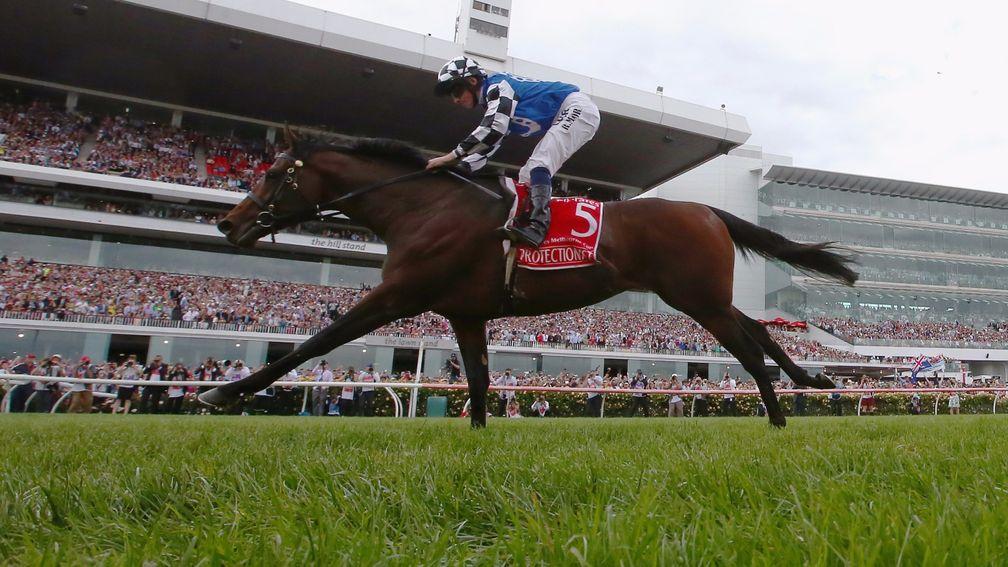
Success at the Curragh for Lazy Griff, the Epsom runner-up, would be a welcome result for a syndicate taking on the world with an enterprisingly bought son of Melbourne Cup hero Protectionist but, in the long term, it would be better to see the sequence continue with a Derby winner sired by this Derby winner with a place for Lambourn at stud. He really needs to win here, and to keep on winning, for any chance of that happening.
There are clearly ways to improve the experience and occasion of a Derby day but none seem achievable without the races themselves being restored to the sporting pinnacle.
After all, no-one would go to Chelsea just to see a garden of stinging nettles and Leylandii or watch some duffer taking chunks out of Augusta National. The product comes first.

Read next:
Published on inBloodstock
Last updated
 Copy
Copy- 'Every time he races there's always a bit of a gathering at home' - Ka Ying Rising's breeder makes the journey of a lifetime with Hong Kong's sprinting sensation
- 'We thought he would be unattainable' - Scorthy Champ joins new adventure at Barton Stud
- Group 1 four-timer sees Jackson-Stops seal Bloodstock Agent of The Year title
- Ben Shoare appointed nominations manager at Ace Stud
- 'It's an absolute fairytale' - Jax Junior helps small breeders topple a giant at Kempton
- 'Every time he races there's always a bit of a gathering at home' - Ka Ying Rising's breeder makes the journey of a lifetime with Hong Kong's sprinting sensation
- 'We thought he would be unattainable' - Scorthy Champ joins new adventure at Barton Stud
- Group 1 four-timer sees Jackson-Stops seal Bloodstock Agent of The Year title
- Ben Shoare appointed nominations manager at Ace Stud
- 'It's an absolute fairytale' - Jax Junior helps small breeders topple a giant at Kempton