


A 'deformed' sire withdrawn from service, a casualty of war and a bad-tempered 'bum' – how dual Arc winners fared at stud


Click here to add us to your Google preferred sources or find out more here
Good Morning Bloodstock is an exclusive daily email sent by the Racing Post bloodstock team and published here as a free sample.
On this occasion, Martin Stevens takes a look at what dual Arc winners achieved at stud – subscribers can get more great insight every Monday to Friday.
All you need do is click on the link above, sign up and then read at your leisure each weekday morning from 7am
The breeding of back-to-back Prix de l’Arc de Triomphe hero Daryz was dealt with in Good Morning Bloodstock after his first success in the Longchamp showpiece this time last year.
So, instead of going over old ground, I thought I’d whet the appetite for the four-year-old colt’s stallion career – which looks likely to start next year, judging by connections’ comments – by looking at what other dual Arc winners achieved at stud.
Tattersalls Book 1 runs from Tuesday to Thursday this week – follow our live blog each morning as bloodstock giants gather in Newmarket.
Ksar
1918 ch h Bruleur-Kizil Kourgan (Omnium)
Won 1921, 1922
The winner of the second and third editions of the Arc, as well as a heap of other big races including the Prix du Jockey Club to make him the leading prize-money earner of his age, was bought by Edmond Blanc and raced by his widow after his death in 1920.
He was bred by Evremond de Saint-Alary at his Haras de Saint-Pair du Mont in Normandy and was the product of a mating between two winners of the Grand Prix de Paris – his sire Bruleur, who also won the Pix Royal-Oak, and his dam Kizil Kourgan, who also took the Poule d’Essai des Pouliches, Prix de Diane and Prix Lupin. Somewhat ironically, Ksar flopped in the Grand Prix de Paris himself.
His pedigree featured tight inbreeding to the great Omnium – 3x2 on paper – and he was described by Blanc as having many of the same conformational faults as his double ancestor, which is why he had been sold by his breeder as a yearling.
Ksar might not have been much of a looker but he was brilliantly well bred and brilliantly talented, which stood him in good stead when he retired to Madame Blanc’s Haras de Jardy. He carved out a successful career as a sire, delivering Classic winners Le Ksar, Thor, Tourbillon and Ukrania among other high-class horses.
Ksar’s name endures in pedigrees today thanks in large part to Tourbillon, who became a foundation stallion for Marcel Boussac’s Haras de Fresnay-Le-Buffard in Normandy and supplied the leading French sires Djebel and Goya.
Hero of the hour Daryz traces back to Ksar several times: for one, his paternal grandsire Cape Cross’s dual Group 1-winning dam Park Appeal was by Ahonoora, whose male line traced back to Djebel; and, for another, his tail-female line goes back to Darazina, who was inbred 4x3 to Djebel.
Motrico
1925 b h Radames-Martigues (Dorocles)
Won 1930, 1932
Motrico, a son of Grand Prix de Saint-Cloud and Prix d’Ispahan winner Radames owned by Vicomte Max de Rivaud, regained his Arc crown in highly unusual circumstances.
The tale was related by racing columnist ‘Regular’ in The Bystander in October 1932.
“I have seen the best horse in the world – not only is he the best horse in the world, but he is the most amazing horse that was ever foaled,” they wrote rather excitedly.
“Two years ago, after a long and honourable career (among his victories being the Prix de l’Arc de Triomphe), Motrico was retired to the stud, and, as was only befitting to so noble an animal, he was presented with twenty-four wives.
“Now Motrico was a good, and I almost said faithful, husband, though zealous, I think, is a more apt word, and eighteen of his wives were blessed with little ones.
“I should have said earlier that Motrico had one peculiarity. Actually, he had four peculiarities, which were in the shape of the most amazing legs you have ever seen – his pasterns running parallel with the ground, and, in consequence, his fetlocks almost touching it.
“That Motrico should be a good racehorse, despite his deformity, was considered to be a million to one chance, and his owner, Vicomte Max de Rivaud, decided that should any of Motrico’s children be similarly deformed, he should be sent back into training.
“Imagine, then, the dismay when every one of Motrico’s eighteen children were found to have legs like father. It was a sad day at the haras. Slowly and sadly they led him away, his twenty-four wives and eighteen crooked-legged children neighing their farewells, back to the training establishment of M. d’Okhuysen at Maisons-Laffitte.
“Now when a horse has been married, he feels himself entitled to feminine society, and is apt to kick up rather a fuss if he is deprived of it. Not so Motrico. He never appeared to give a thought to those love-sick brides at the far-away haras, nor to any other ladies he met in the course of his day’s work.
“Away from the cares and worries of his harem at the haras, Motrico once more gave all his attention to running faster than his fellows, and once again this year won the Prix de l’Arc de Triomphe, beating all the best horses in France, the two crack Italian horses, Fenolo and Sanzio, and our old friend, Goyescas, carrying the maximum weight of 60 kilos.
“True victory, too, was gained under the most exciting conditions, as when he went to make his effort on Motrico, turning into the straight, Semblat found his way blocked by a wall of horses, and he had to come round the lot, thereby covering a furlong more than anyone else.
“Now comes the sequel. All Motrico’s children have outgrown their early deformity, and not one of them now has legs like father.”
That account – inaccurate, infantile and anthropomorphising horses – is one in the eye for all those people who think everything was better in the Good Old Days. Never complain about the standard of my writing again!
One of the 18 crooked-legged children who supposedly neighed farewell to Motrico when he left 'the haras' to re-enter training turned out to have a huge impact on British and Irish jump racing – namely Vulgate, whose son Vulgan was a prolific champion sire in the mid 20th century and supplied Grand National heroes Team Spirit, Foinavon and Gay Trip.
Motrico’s second stint at stud as a dual Arc winner yielded Prix Royal-Oak victor Spooney and Grand Steeple-Chase de Paris scorer Hahnhof, as well as the filly Roquebrune, who clicked with Ksar’s son Tourbillon to produce the top-class Fort Napoleon, later an important sire in Brazil.
Corrida
1932 ch m Coronach-Zariba (Sardanapale)
Won 1936, 1937
Marcel Boussac’s homebred daughter of Derby hero Coronach and half-sister to the aforementioned French champion sire Goya was the first filly or mare to win the Arc twice and is generally regarded as one the best female racehorses of the 20th century.
Her story had a desperately sad ending, though. Her retirement to stud coincided with the onset of the second world war, and later the German occupation of France, and she produced only one foal who survived into adulthood before she was stolen from her paddock at Haras de Fresnay-Le-Buffard during the Battle of Normandy. No trace of her was ever found and it has been speculated that her captors might have eaten her.
The calamity of Corrida’s demise was magnified by the fact that her sole surviving offspring, the Tourbillon colt Coaraze, won a heap of important races that would now be designated Group 1 status, including the Prix du Jockey Club and Prix d’Ispahan, twice.

Boussac initially stood Coaraze in France but sold the horse to Brazil a few years later, having reportedly been discouraged by him siring too many twins in his first crop. He was wildly successful in South America and left deep roots there.
Coaraze’s early French output included Prix Jacques Le Marois winner Canthare, whose pedigree features some typically Boussacesque inbreeding, as his dam Ista was by Goya, a Tourbillon half-brother to Corrida, remember; and La Mirambule, who won the Prix Vermeille and finished second in the Arc, and became the dam of King George VI and Queen Elizabeth Stakes hero Nasram and Irish Derby winner Tambourine.
The tragic Corrida figures in the pedigrees of black-type winners in Europe on a regular basis thanks to Coaraze’s few French-conceived crops, especially La Mirambule.
Prolific sire Lope De Vega’s tail-female line traces back to La Mirambule, whose family also encompasses Arc hero Sagamix, Newsells Park Stud blue hen Shastye and Middle Park Stakes-winning half-brothers Perfect Power and Wise Approach.
La Mirambule’s son Nasram meanwhile supplied Naskra, who in turn sired the maternal granddams of influential stallions Maria’s Mon and More Than Ready.
Another of Coaraze’s daughters, Prix de la Nonette winner Chimere Fabuleuse, was the third dam of Irish Derby runner-up and Derby third Silver Hawk, who made his mark as the sire of European Classic winners Benny The Dip, Lady In Silver and Mutafaweq and as the damsire of Nathaniel – source of another dual Arc winner in Enable.
Tantieme
1947 b h Deux Pour Cent-Terka (Indus)
Won 1950, 1951
Remarkably, Daryz is the first French-trained male to win the Arc twice since Tantieme three-quarters of a century ago.
Tantieme was bred by Francois Dupre at his Haras d’Ouilly in Normandy and was by Grand Prix de Paris victor Deux Pour Cent and out of the Indus mare Terka, making him a full-brother to the useful pair Centuple and Teacher.
He was trained by Francois Mathet to win a host of important races, including the Poule d’Essai des Poulains, Prix Ganay and Coronation Cup, before he returned to Haras d’Ouilly to take up covering duty.
Tantieme was indisputably a great success as a sire, and was twice crowned champion in France, in 1962 and 1965. His best performers included Reliance, successful in the Prix du Jockey Club and Grand Prix de Paris and runner-up to Sea-Bird in the Arc; Match, whose big-race haul included the King George and Washington DC International; La Sega, who completed the Poule d’Essai des Pouliches and Prix de Diane double; Danseur, who won the Grand Prix de Paris and Prix du Cadran; and Tanerko, a dual winner of the Grand Prix de Saint-Cloud.
Tantieme made an impact in subsequent generations too.

Reliance supplied a few good sorts at stud, including Prix du Cadran victor Recupere and leading stayer Proverb, but he fared much better as a broodmare sire. His daughters included blue hen Doubly Sure, the source of Diesis, Kris, Rudimentary, Keen and Presidium, and the dams of crack sprinter Moorestyle, Gold Cup winner Longboat, St James’s Palace Stakes scorer Persian Heights, top German horse Surumu, Kauto Star’s sire Village Star and Sprinter Sacre’s sire Network.
Match delivered the Yorkshire Oaks heroine Palatch, Queen Elizabeth II Stakes winner World Cup and Coventry Stakes scorer Murrayfield, and was the damsire of Irish Champion Stakes heroine Park Express, who later produced New Approach.
Tanerko meanwhile wrote his name in the history books by siring the Derby winner Relko and the dam of Prix du Jockey Club winner Rheffic. Relko came up with a number of celebrities in his own stallion career, including Give Thanks and Relkino, and also featured as damsire of Classic-winning siblings Fairy Footsteps and Light Cavalry, as well as top-notch fillies Royal Heroine, Sarah Siddons and Swiftfoot.
La Sega also left an indelible mark on the breed by producing Prix de Flore winner Sega Ville, whose son Top Ville became a noted sire of sires in the National Hunt realm and was an important influence in Flat breeding, but mainly through his daughters, who produced the likes of Montjeu, Yeats, Voix Du Nord, Dar Re Mi and Caerlina.
Tantieme’s son Agio, a winner of the German St Leger, meanwhile sired dual German horse of the year Lombard, who in turn sired Allegretta, the dam of Urban Sea.
You should have the message by now: Tantieme is everywhere in pedigrees. His distant descendant Daryz, by Urban Sea’s son Sea The Stars, will be doing well to emulate his influence.
Ribot
1952 b Tenerani-Romanella (El Greco)
Won 1955, 1956
Ribot became Federico Tesio’s masterpiece but the legendary Italian breeder probably wouldn’t have guessed that would be the case when he planned the mating.
Tesio bred the colt from his Italian triple crown winner Tenerani, who he considered to be too stamina-laden and too plain to cover his own elite mares, prompting his sale to the National Stud in England for not all that much money.
However, Tesio sent Tenerani his mare Romanella, a fast two-year-old who didn’t train on at three, and the result was Ribot, who was unbeaten in 16 starts over three seasons including the King George and two Arcs. Sadly, Tesio never saw the best horse he bred compete on the racecourse, as he died two months before he made his debut.
Ribot – still in the ownership of Lydia Tesio, the widow of Federico, and the Marchese Incisa della Rochetta – was retired to stand at Lord Derby’s Woodland Stud in Newmarket in 1957 on a one-year-term at a record introductory fee of £1,200.
John W Galbraith, the owner of Darby Dan Farm in Kentucky, bought a quarter of the stallion rights in Ribot in 1958 and sent mares to Italy to be covered by him, and in 1959 he arranged a deal to stand the horse at Darby Dan for five seasons from 1961.
Ribot made the trip to the Bluegrass but was never repatriated to Italy due to his volatile nature. He managed to jump over the half-door of his stable, turned an iron bucket hooked on the wall into a battered wreck, left high wooden beams splintered and buckled solid metal bars that were fitted in his box.

European breeders were not best pleased with losing direct access to Ribot, but his custodians in Kentucky weren’t all that enamoured with the idea of him staying either.
“I wish they’d taken the sonuvabitch back first time,” said the farm manager Olin Gentry in an interview in 1967. “He interfered with the routine of the whole place.
“I have to clear the farm for a mile around every time we turn him loose. Any other horses in sight, or even steers, and he goes crazy. He could tear a fence down in three minutes and tear himself apart doing it.
“This costs a lot of time and money. Thirty-five yearlings have to be shut up two hours early every day, just so we can let that bum out. He can go the hell on back to Italy any time. Once in a while he will have a brainstorm even in his stall, and we have to slip him a tranquiliser.”
Ribot was worth the hassle, though, as he was an outstanding sire – champion in Britain and Ireland on three occasions. His best offspring included Arc winners Molvedo and Prince Royal, European Classic scorers Boucher, Long Look, Regal Exception, Ragusa, Ribocco and Ribero, as well as North American stars Arts And Letters and Tom Rolfe.
He was also the damsire of Kentucky Derby victor Cannonade and European Classic winners Bireme and Dark Lomond.
“Don’t you go writing that he’s a maniac,” Gentry went on to tell his interviewer nearly 60 years ago. “He ain’t. He’s a great stud, breeds true, and could easily take 50 mares at 15,000 dollars a time instead of 40.
“We know how to manage him good now, and he’s like a lamb at times. He’s a real character, but just a nut! We never said he couldn’t go home. The Italians made the decision, after we turned him over and they couldn’t handle him.
“He could be got on a plane all right, but you can’t tranquilise him all the way. Nobody would get in there with him, except with a shotgun and an axe – and what good’s a dead horse? They’d have to do it if he went wild.”
Shudder. Daryz looks very well-behaved and so his stallion career should be far more straightforward than it was for the fiery Ribot.
Alleged
1974 b h Hoist The Flag-Princess Pout (Prince John)
Won 1977, 1978
Alleged was descended from two other dual Arc winners as his sire Hoist The Flag was by Ribot’s son Tom Rolfe and out of Wavy Navy, whose damsire was Tourbillon.
Trained by Vincent O’Brien for Robert Fluor and Robert Sangster, he took the scalps of New Zealand champion Balmerino, Prix du Jockey Club hero Crystal Palace and his St Leger conqueror Dunfermline to win his first Arc in 1977 and defeated the crack fillies Trillion and Dancing Maid when he successfully defended his title in the following year.
Alleged was sold to stand in Walmac International in Kentucky in a deal that netted $16 million for Sangster and his partners in their pursuit of profitable stallion prospects.
He proved to be a rich source of talent, especially over middle distances in Europe. His leading runners included European Classic winners Hours After, Law Society, Leading Counsel, Midway Lady, Shantou, Sir Harry Lewis and Strategic Choice.

Frustratingly, because his progeny tended to stay well, and they operated in an era in which stamina was becoming a dirty word, his sire-line quickly petered out in Flat breeding. It did make him an attractive National Hunt sire of sires, though, and his sons Flemensfirth and Shantou excelled in long careers as jumps stallions.
Alleged’s daughters have longer-lasting legacies as far as Flat breeding goes. He was the damsire of numerous luminaries, including Designs On Rome, Dr Devious, Dubai Destination, Go And Go, Pride, Suave Dancer and Sulamani.
Alleged was the source of several blue-hen mares – such as Alleged Devotion, who produced nine winners including Devoted To You, the dam of Jan Brueghel and Sovereign; Eva Luna, the dam of Brian Boru, granddam of Workforce and ancestress of Best Solution and Loving Dream; and Mysterial, the dam of Dubai Destination and Librettist and granddam of Real World and Royal Marine.
Alleged was clearly an influence for stamina, class and toughness, but he was also known for imparting a little artistic temperament, with Law Society and Shantou among his sons who had their own ways of doing things.
Treve
2010 b m Motivator-Trevise (Anabaa)
Won 2013, 2014
The Head family’s homebred had a pedigree that represented a blend of stamina and speed, being by the Derby winner Motivator and out of Trevise, a five-furlong winner by top sprinter Anabaa, and she showed that when she stalked her rivals and pounced on them with a hair-trigger burst of acceleration in her back-to-back Arc victories.
Treve has been more miss than hit in her broodmare career for her main racing owner Al Shaqab Racing so far, though. She has five offspring of racing age but only three have raced and two have won – Qous (by Dubawi), who scored once, in a Chantilly conditions stakes, from eight starts; and Doha (by Sea The Stars), who did much better by taking the Kensington Palace Stakes at Royal Ascot and the Listed Prix Dahlia at Saint-Cloud.

Treve has had a bit of bad luck too, to be fair, as her covers by Kingman in 2020 and 2021 resulted in a dead foal and no return. She has a two-year-old filly by Frankel, a yearling colt by Wootton Bassett and a filly foal by Wootton Bassett, and she was covered by St Mark’s Basilica this year.
Perhaps Treve will be one of those exceptional racemares whose talent skips a generation, and she will have lots of high-class grandchildren. She has plenty of daughters for that to be the case, including the placed Paris (by Shalaa) and unraced Kaltham (by Siyouni), while Doha was covered for the first time this year, by Zarak.
Enable
2014 b m Nathaniel-Concentric (Sadler’s Wells)
Won 2017, 2018
Juddmonte’s homebred wondermare is making us breeding aficionados wait.
She has a four-year-old colt by Kingman named Encompass, a three-year-old filly by Dubawi named Envisage and a two-year-old colt by Dubawi named Entrust, all of whom entered training with John and Thady Gosden but none of whom have run – yet.
Hopefully at least one of those horses will make it to the racecourse as otherwise we’ll have to endure an even longer wait to see her represented as the dam of a runner, as she was barren after being covered by Dubawi in 2024, and so has no yearling, and the Siyouni colt foal she produced this year is recorded as having died since birth.
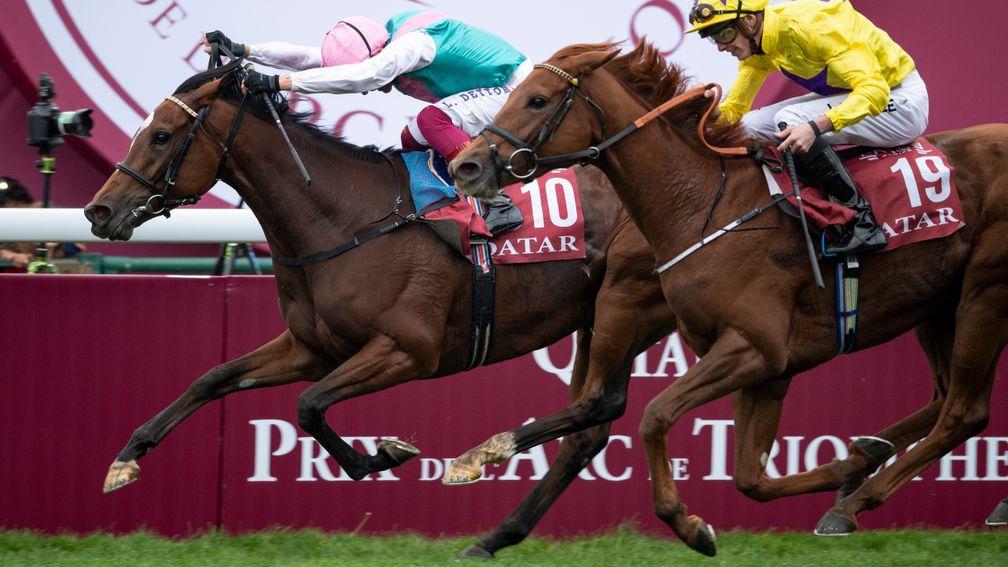
Enable was covered by Dubawi again this year.
Juddmonte have proved to be pretty good at devising matings over the years, so they certainly don’t need advice from me, but wouldn’t it be something if they one day sent her to Daryz to produce a rare foal whose parents won four Arcs between them?
It would work in one respect, at least. Enable is, famously, inbred 3x2 to Sadler’s Wells, whereas Daryz isn’t descended from the Coolmore patriarch at all.
Refer a friend!
If you have a friend who would like to receive Good Morning Bloodstock please send the following link where they can sign up.
What do you think?
Share your thoughts with other Good Morning Bloodstock readers by emailing gmb@racingpost.com
Must-read story
This story is exclusive to Racing Post + Ultimate subscribers. Sign up here to get unlimited access to our premium stories.
“I don’t have my own plane although I’m looking to buy one – they’re not very cheap,” says Jack Mitchell in this week’s Racing Grapevine as the jockey becomes the only active British-based jockey with a pilot's licence.
Pedigree pick
Sayaarr’s breeding suggests he should be able to put his best foot forward at two.
The colt, who makes his debut for Ed Bethell and the late Sheikh Ahmed Al Maktoum’s ARM Racing in the seven-furlong maiden at Southwell (6.30), is a Dark Angel full-brother to dual-winning and Group 3 and Listed-placed juvenile Kumite.
He is out of Nawassi, a two-year-old winner at Newmarket by Dubawi and out of Queen Mary Stakes heroine and 1,000 Guineas third Maqaasid, and he hails from a branch of the brilliant Height Of Fashion family that also yielded the top-class Ghanaati.
Sayaarr was bought by Federico Barberini from his breeder Yeomanstown Stud’s draft at Book 1 of the Tattersalls October Yearling Sale last year for 170,000gns.

Read these next:
British breeders syndicate secures Kameko from Qatar Bloodstock as sire stays at Tweenhills

Good Morning Bloodstock is our unmissable email newsletter. Leading bloodstock journalist Martin Stevens provides his take and insight on the biggest stories every morning from Monday to Friday.

Published on inGood Morning Bloodstock
Last updated
 Copy
Click here to add us to your Google preferred sources or find out more here
- Mamma Mia! How Abba legend Benny Andersson is behind a budding blue hen and her brilliant family
- 'He likes to have things his own way' – the all-American Breeders' Cup legend still pleasing the public at nearly 30
- Who's in and who's out? The Return of Mares reveals the winners and losers in this year's stallion popularity stakes
- Capital Stud going all in on the Wootton Bassett sire-line with two top-class new recruits for 2027
- 'I’ve had a fair bit of luck with greys, so I’m always trying to breed them' - catching up with Desert Orchid's in-form owner
- Manchester United vs Aston Villa offer: get 50-1 for a goal to be scored with Sky Bet
- England vs Australia: back England at 50-1 OR Australia at 60-1 with Sky Bet
- Nottingham Forest vs Man City offer: get 50-1 on Man City to win with Paddy Power
- William Hill Aintree offer: get £40 in free bets on Saturday’s racing